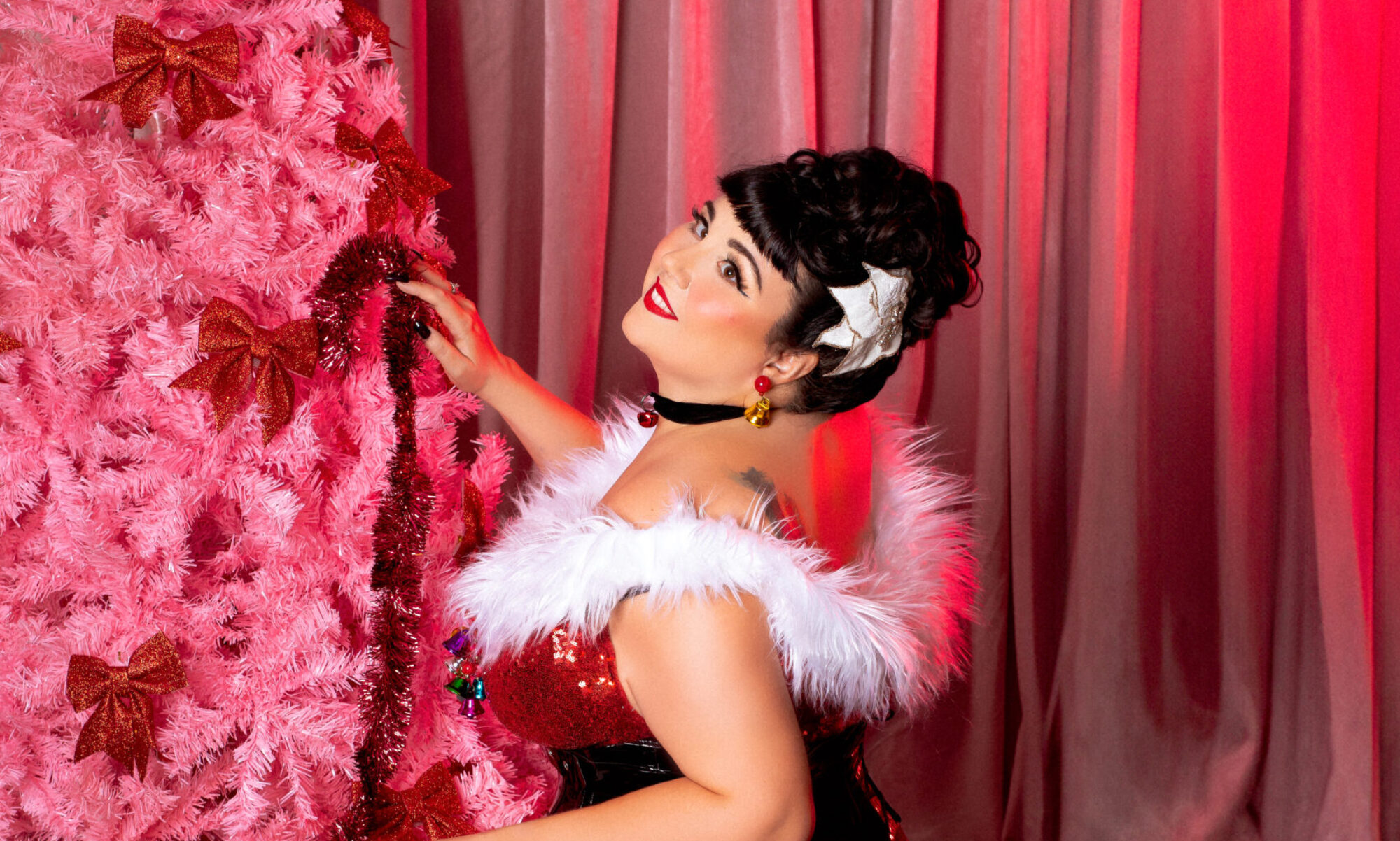
This blog is a hodgepodge, so i figure I should adapt it for more gloriously random uses. I think I’ll start posting some of the outfits I slap up on various fashion communities. I will also endeavor to post the interesting media (or not-so-interesting media) that I’m always slapping up on Facebook. And other stuff. I promise.
Kali and friends at the Mansion's 30th anniversary festivities, 1999.
So I’ve been woefully out of touch with the Haunted Mansion scene lately, partly because I don’t have time and partly because I’m sick to death of the merch-o-rama effect that surrounds every attraction milestone. I didn’t attend the 40th anniversary festivities that coincided with the D23 Expo back in September, but I did find this cute interactive Haunted Mansion feature at the Disney site. It features a version of Rolly Crump’s Corridor of Doors wallpaper (for your desktop – basically a larger version of what I offer at Better Haunts & Graveyards), a video clip on the mansion, a stretching portrait gag, little photo galleries, and more. Oh, and it also features my Disney alterego, Marc Davis’ April D., morphing from April to June to September to December. 🙂
This animation sequence was released as the “Blue Bayou” segment in Walt Disney’s Make Mine Music (1946), one of several Walt Disney “composite” releases of the mid-late 1940s. Originally, however, it was created to accompany Claude Debussy’s Clair de Lune as an additional segment for Fantasia. Initially, Mr. Disney had intended Fantasia to be a fluid, changing concept, to which new pieces would be added with each re-release. For a number of reasons (the 1941 animators’ strike, WW2,…), that concept didn’t pan out (at least, not until Fantasia 2000…kind of). In 1998, the original version of Clair de Lune was restored and screened at the London Film Festival.
I’m a huge, huge, huge 1964-65 New York World’s Fair fan. And on May 23, I finally got to visit the Mecca of NYWF fandom – CORONA PARK at Flushing Meadows in Queens! My good-natured friend Dasha accompanied me. In fact, she assisted me greatly by taking a few photos (See a galleryful of my Corona Park images here).
Here are a few pics of the Unisphere, the fair’s official symbol and the embodiment of the fair’s aim: Peace through [global] understanding.
“It will remain as a permanent reminder of man’s aspirations for peace through understanding, and a symbol of his achievements in an expanding universe. Unisphere is truly the miracle in the meadow.”
This 900,000 pound stainless steel structure was designed by Gilmore Clark and engineered/constructed by United States Steel’s American Bridge Division.
Kali, the Unisphere, and the New York State Pavilion towers. Photographed by Dasha.Classic shot of the Unisphere with USTA-Arthur Ashe Stadium in the background. The tennis stadium sits where the Federal Building (aka the United States Pavilion) sat during the fair (and until 1976, when it was finally removed). Photo by Kali Pappas.The Unisphere and the New York State Pavilion observation towers. By Kali Pappas.NYS Pavilion observation towers, viewed through the "roof" of the Tent of Tomorrow. By Kali Pappas.More NYS Pavilion observation deck action. By Kali Pappas.
You can learn more about the Unisphere, the NYS Pavilion, and the rest of the fair at NYWF64.com, an excellent resource for NYWF enthusiasts.
Used to monitor number of Google Analytics server requests when using Google Tag Manager
1 minute
_gid
ID used to identify users for 24 hours after last activity
24 hours
_ga_
ID used to identify users
2 years
_gali
Used by Google Analytics to determine which links on a page are being clicked
30 seconds
_ga
ID used to identify users
2 years
__utmx
Used to determine whether a user is included in an A / B or Multivariate test.
18 months
__utmv
Contains custom information set by the web developer via the _setCustomVar method in Google Analytics. This cookie is updated every time new data is sent to the Google Analytics server.
2 years after last activity
__utmz
Contains information about the traffic source or campaign that directed user to the website. The cookie is set when the GA.js javascript is loaded and updated when data is sent to the Google Anaytics server
6 months after last activity
__utmc
Used only with old Urchin versions of Google Analytics and not with GA.js. Was used to distinguish between new sessions and visits at the end of a session.
End of session (browser)
__utmb
Used to distinguish new sessions and visits. This cookie is set when the GA.js javascript library is loaded and there is no existing __utmb cookie. The cookie is updated every time data is sent to the Google Analytics server.
30 minutes after last activity
__utmt
Used to monitor number of Google Analytics server requests
10 minutes
__utma
ID used to identify users and sessions
2 years after last activity
_gac_
Contains information related to marketing campaigns of the user. These are shared with Google AdWords / Google Ads when the Google Ads and Google Analytics accounts are linked together.